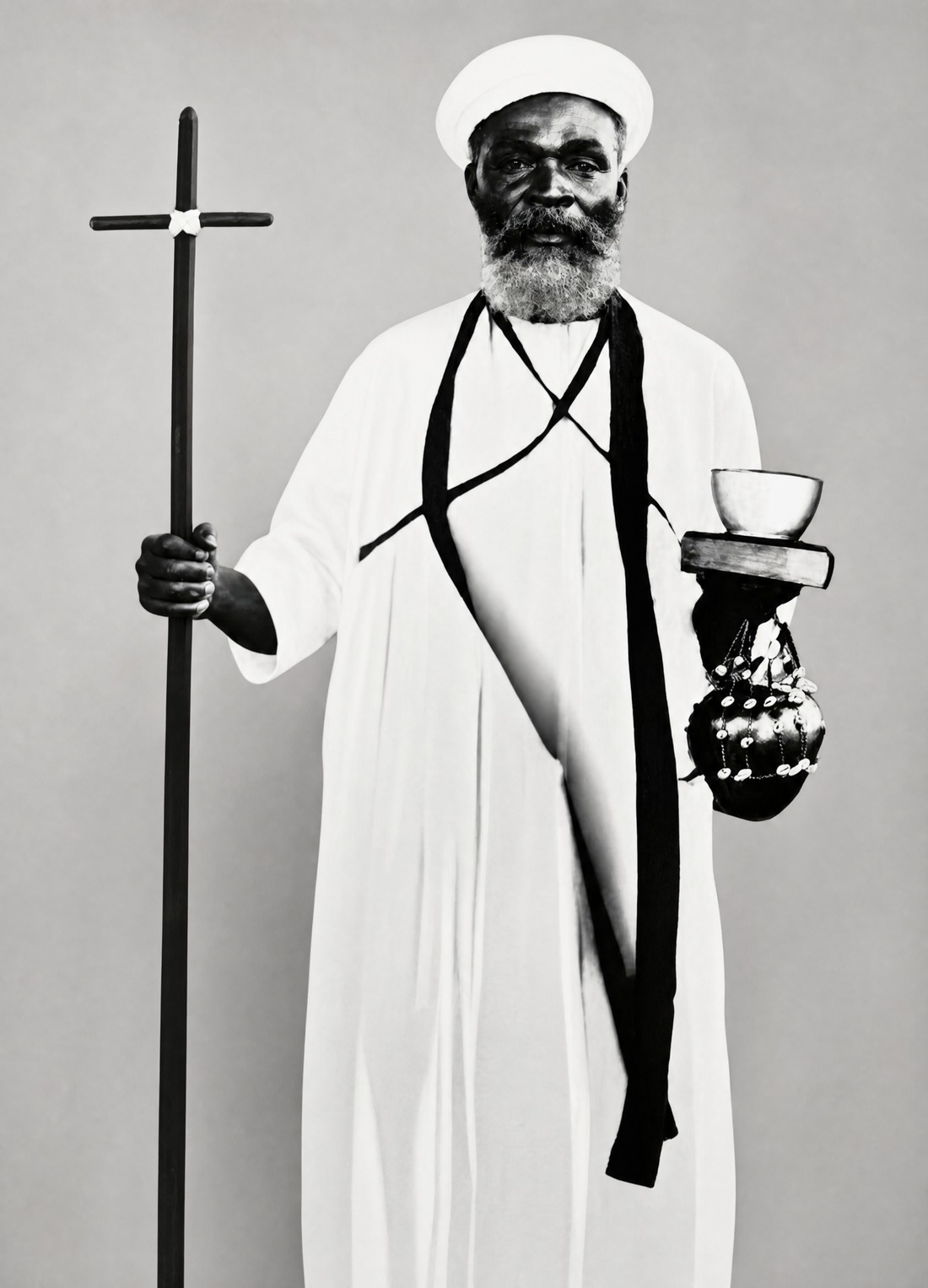
Origins
Born around 1860 in Liberia, William Wadé Harris belonged to the Grebo people. He grew up near a Methodist mission, where he was educated and baptised. Having become a catechist and teacher, he was employed from 1892 as a teacher in an American Episcopal mission, and was drawn early into his country's political affairs.
The vision in prison
Involved in a political protest movement in Liberia, Harris was imprisoned in 1910. It was in his cell, he later said, that he was visited by the archangel Gabriel, who entrusted him with a mission : to walk the coast and tell the people it was time to abandon the old cults and turn to one God. From then on he identified with the biblical prophet Elijah — historian David A. Shank would later call him the "Black Elijah of West Africa", while Ivorian historian Christophe Wondji called him the "Black Christ of the lagoons".
The prophetic walk
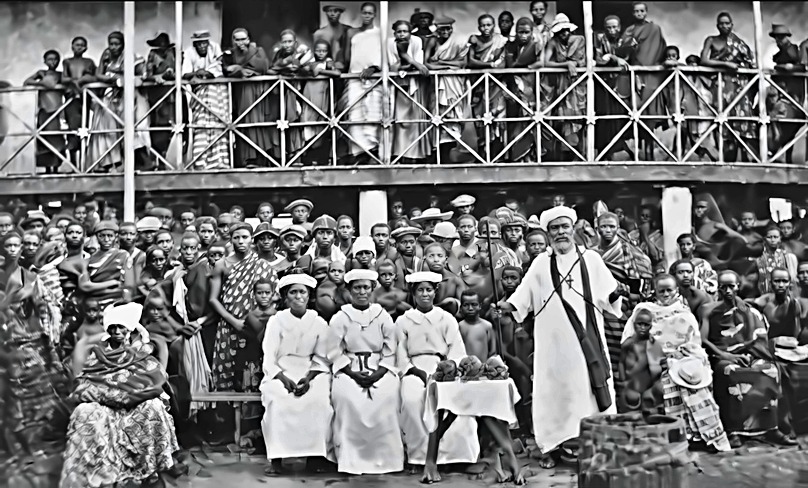
Once freed, Harris left Liberia and began, on 27 July 1913, a long coastal walk that took him through Ivory Coast — through Alladian, Avikam and Ébrié territory — and on to Axim, in the west of the Gold Coast (present-day Ghana). Dressed in white, a turban on his head, a bamboo cross and a Bible in hand, a calabash rattle keeping time with his prayers, he was accompanied by women singers who sang and danced at his side — first Helen Valentine and Mary Pioka, then Grace Tani.
He urged crowds to burn their traditional cult objects and baptised by immersion more than a hundred thousand people in barely eighteen months — a pace American historian Sheila S. Walker would call a true "religious revolution" in her study of the Harrist Church.
The prophet's objects
- The bamboo cross — a symbol of his mission and authority.
- The Bible — which he knew by heart, without ever imposing it by force.
- The calabash rattle — a traditional instrument keeping time with prayers and songs.
- The water bowl — filled for baptisms, administered by immersion or by aspersion depending on the place.
- The white robe — a sign of purity and a break with the old life.
Message and teaching
Harris's message remained broadly orthodox, but he tolerated polygamy — a flexibility that the future Harrist institution, under John Ahui, would later reserve for lay believers while imposing monogamy on its preachers.
He did not seek to found a Church : according to the biography written by Paul William Ahui, son of John Ahui, he asked those he baptised to await the arrival of white missionaries bearing the Book to continue their religious instruction. These were words later misinterpreted, which the prophet would place back in their context during the delegation's visit in 1928, entrusting John Ahui with the mission of establishing a Church that, culturally, would resemble the martyred Black people.
Expulsion and final years
Harris's success alarmed the French colonial administration, then absorbed by the outbreak of the First World War, as well as rival Catholic missions. In December 1914 he was arrested, then brutally expelled in January 1915 to Cape Palmas, Liberia. Ethnologist René Bureau recalls, in Le prophète de la lagune, that many of the books and prayer notebooks Harris had left with his followers were then burned or thrown into the sea by the authorities, who saw in them the seeds of insurrection.
Back in Liberia, Harris continued preaching locally until his death in 1929. It was one of his Ivorian disciples, John Ahui, who would take up and structure his work in Ivory Coast.
Sources for this page
- Christophe Wondji, Le prophète Harris, le Christ noir des lagunes, A.B.C. / N.E.A, Abidjan, 1977.
- David A. Shank, Prophet Harris, the "Black Elijah" of West Africa, abr. Jocelyn Murray, E. J. Brill, Leiden, 1994.
- Gordon Mackay Haliburton, The Prophet Harris, Oxford University Press / Longman, 1973.
- Sheila S. Walker, The Religious Revolution in the Ivory Coast, University of North Carolina Press, 1983.
- René Bureau, Le prophète de la lagune. Les harristes de Côte d'Ivoire, Karthala, 1996.
- Paul William Ahui, Le prophète William Wadé Harris, son message d'humilité et de progrès, N.E.A, Abidjan, 1988.
- James R. Krabill, The Hymnody of the Harrist Church among the Dida of South-Central Ivory Coast (1913–1949), Peter Lang, 1995.
- Jean-Pierre Lehmann, Prophètes-guérisseurs dans le sud de la Côte d'Ivoire, BIT / N.E.A, 1982.
- Simon Bolivar Njami-Nwandi, Le harrisme : une Église africaine originelle.
- Andrew Brubacher Kaethler, Christology in African Independent Churches, Wipf and Stock, 2019.
- William James Platt, An African Prophet: The Ivory Coast Movement and What Came of It, SCM Press, 1934.
- E. Amos Djoro, Harris et la chrétienté en Côte d'Ivoire.
- Richard Kwame Johnson, Lessons from the Ministry and Life of Prophet William Wade Harris.