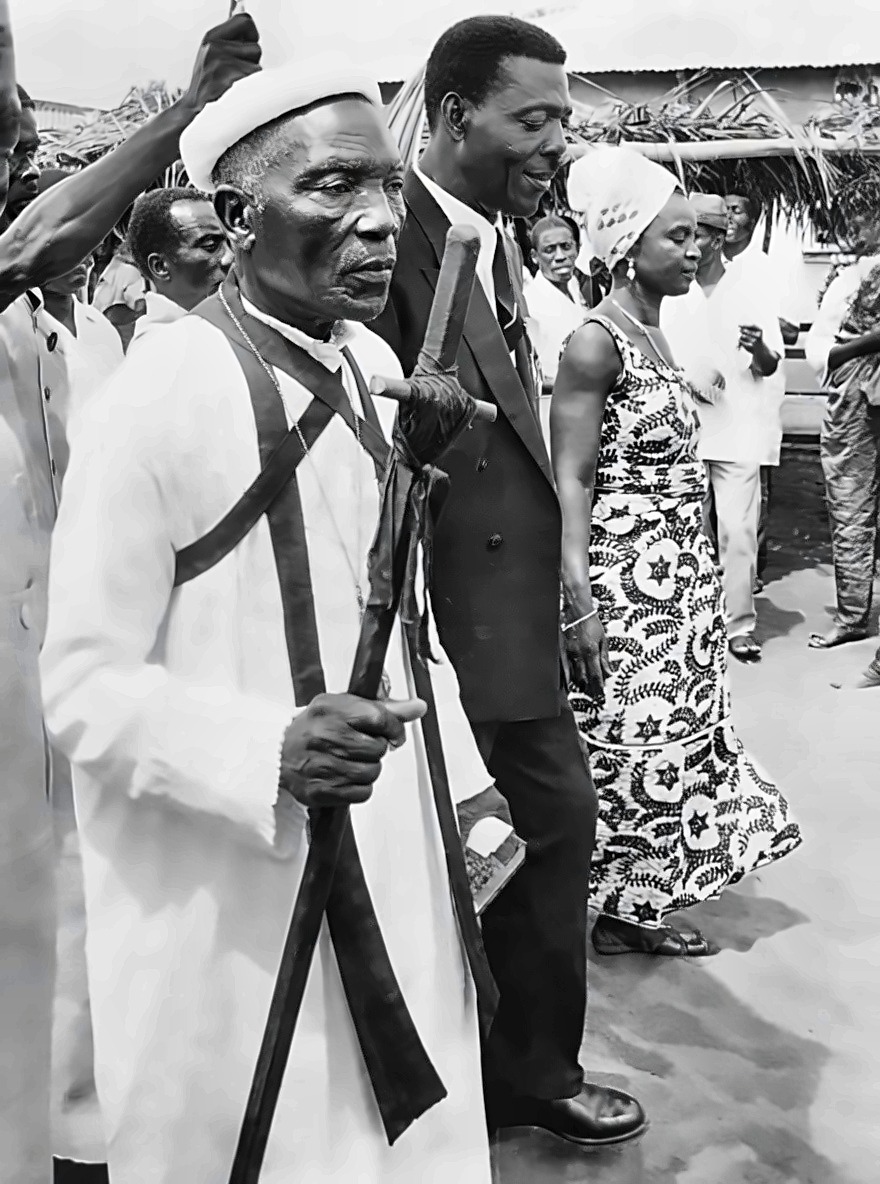
A young man from Abia-Gnambo
Born Nanghui Togba in the Ébrié village of Abia-Gnambo, at Petit-Bassam, he was the son of chief Akadja Nanghui. His godfather renamed him Boghui Ahui. Having become the war-leader of the boys his age, he married Jeannette Tohi in 1910. In 1914, when the prophet Harris passed through Bingerville, he and his father were baptised.
Recruited into the colonial army, he returned to civilian life after an accident and became the most celebrated singer in his village choir. It was in a climate of uncertainty — a resurgence of traditional practices, growing pressure from English Methodist missions — that he would soon play a decisive role.
The journey to Cape Palmas
In December 1928, Ahui travelled to Cape Palmas, Liberia, together with another disciple, Salomon Dagri, to consult the by-then elderly Harris. The prophet raised with them, among other things, unresolved questions on marriage and money collections, and warned against abusive impositions.
At the end of this meeting, Harris gave Ahui his cross, his Bible and a final written message, addressed to the young man's father, designating him to take up the work in Ivory Coast.
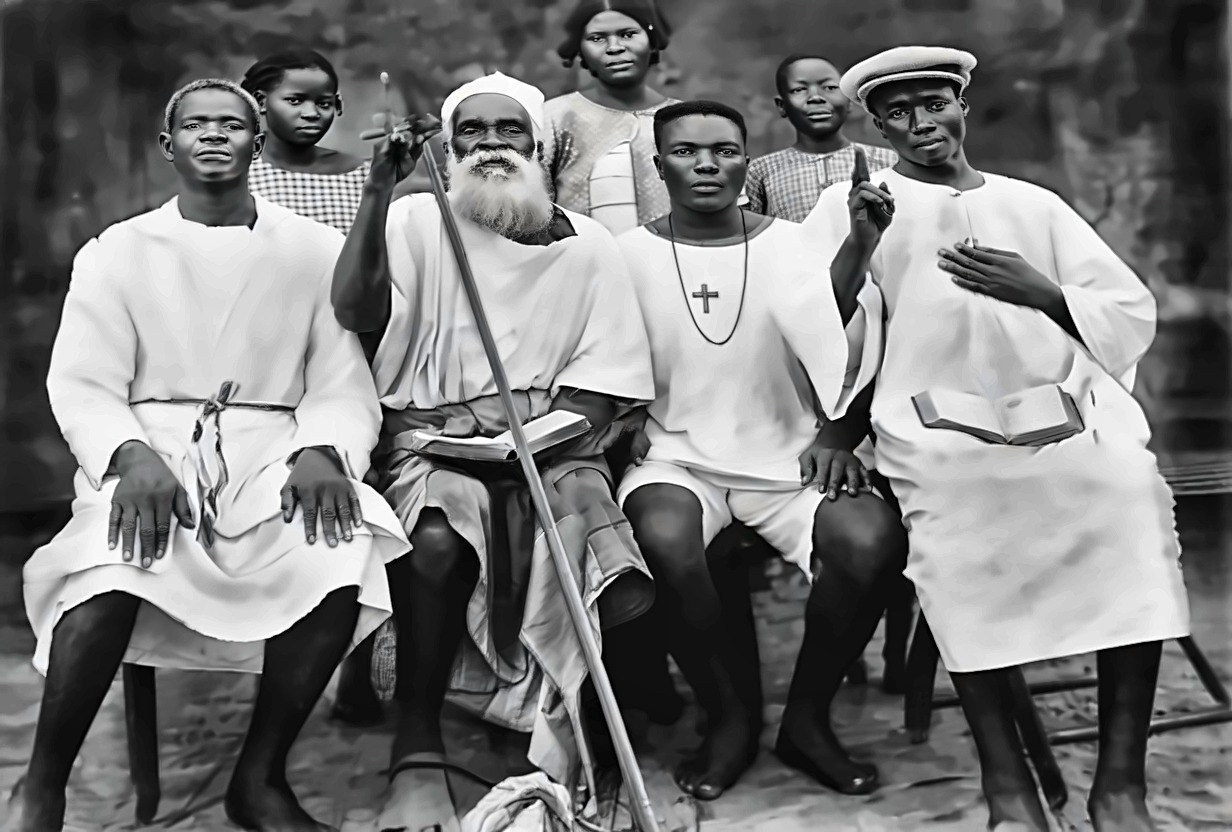
Hesitation and illness
Ahui hesitated for several years before taking up the charge entrusted to him by the prophet. It was an illness that nearly cost him his life, in 1936, that led him to fully relaunch the movement — despite the hostility of the colonial administration, always wary of any popular religious gathering.
He rallied a popular, multi-ethnic movement, and became, despite being unable to read or write, a figure of spiritual authority recognised well beyond his native village.
Structuring the Church
Under his impetus, Harrism became a true institution. The Church adopted a motto — God, Work, Love, Fatherland —, a catechism printed in 1956, then official statutes published in 1961 under the name Christ Church - Harris Mission. The movement, which began in a single lagoon village, then spread as far as Liberia, Burkina Faso, Ghana, Togo and Benin.
Ahui, in a few dates
- 1914 — Baptised by Harris at Bingerville.
- 1928 — Receives the prophet's mission at Cape Palmas.
- 1929, then 1936 — Two successive relaunches of the movement.
- 1956 / 1961 — Catechism, then the Church's official statutes.
- 1992 — Ahui's death, after 57 years leading the Harrist Church of West Africa.
A legacy passed down in the family
It was his own son, Paul William Ahui, who would trace the deep origins of the Liberian prophet's Church through these writings : the prophet's biography, Le prophète William Wadé Harris, son message d'humilité et de progrès (1988), then a more doctrinal work, Église du Christ, Mission harriste. Éléments théologiques du harrisme paulinien (1997), which laid the foundations of a theology proper to the Church born of John Ahui.
Sources for this page
- Paul William Ahui, Le prophète William Wadé Harris, son message d'humilité et de progrès, N.E.A, Abidjan, 1988.
- Paul William Ahui, Église du Christ, Mission harriste. Éléments théologiques du harrisme paulinien, L'Harmattan, Paris, 1997.
- René Bureau, Le prophète de la lagune. Les harristes de Côte d'Ivoire, Karthala, 1996.
- David A. Shank, Prophet Harris, the "Black Elijah" of West Africa, Brill, 1994.
- Dictionary of African Christian Biography, notice « Ahui, John » (dacb.org).