From the prophet of the lagoons to the Church of today : the story of a Christian movement born on the West African coast, between spiritual resistance and lasting roots.
Youth version
The Prophet Harris as seen at Axim in 1914. Source : Gordon Mackay Haliburton, The Prophet Harris.
A Liberian catechist, a night in prison, and a walk of several hundred kilometres along the coast.
Born around 1860 in Liberia into an animist family, William Wadé Harris grew up near a Methodist mission where he was educated and baptised. He became a catechist and teacher, already drawn into his country's political affairs.
A political stance led to his imprisonment around 1910. It was in his cell, he said, that he was visited by the archangel Gabriel, tasked with entrusting him a mission : to walk the coast and tell the people it was time to give up the old cults and turn to one God.
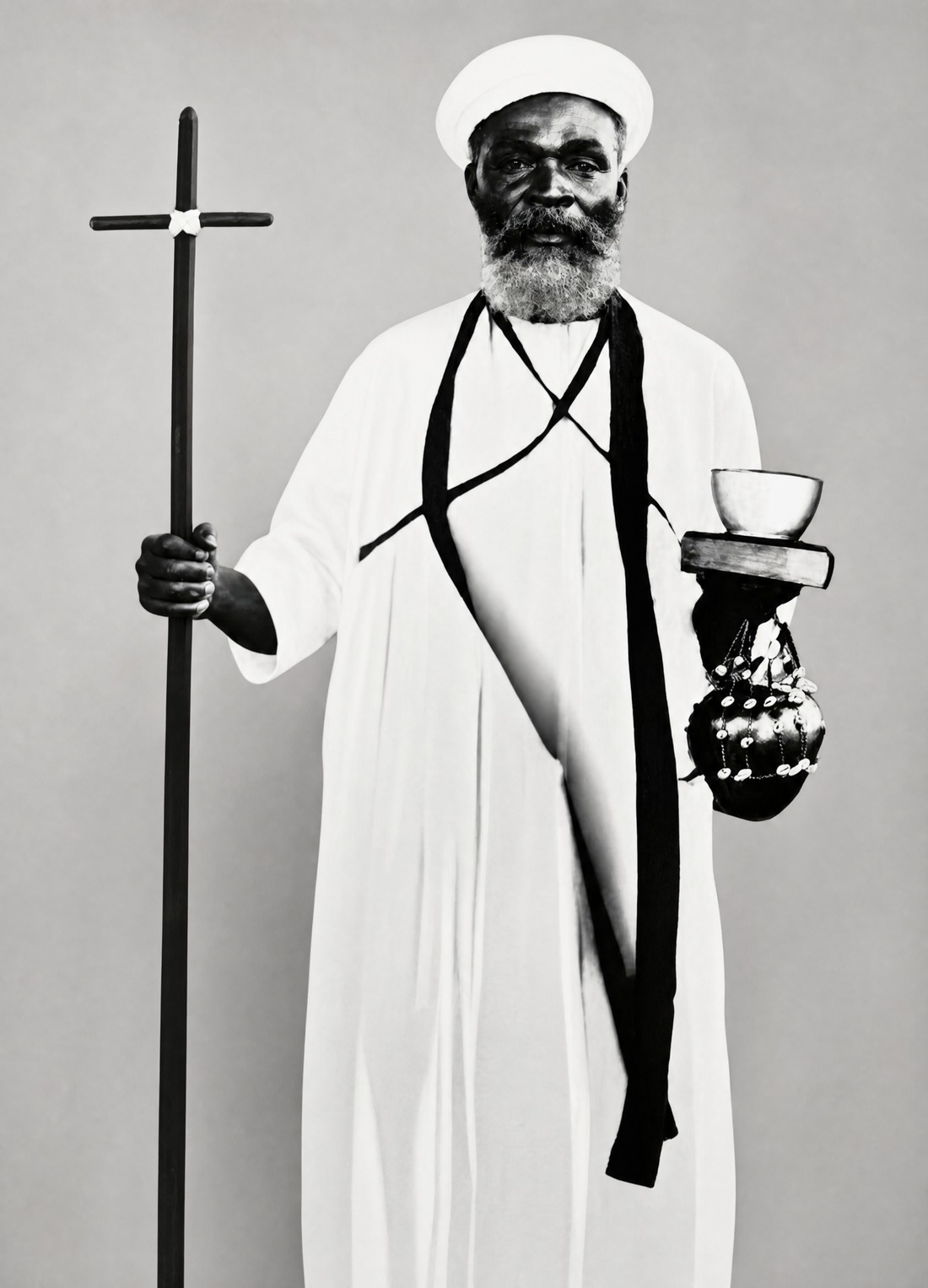
Born into the Grebo people, Harris claimed the biblical prophet Elijah as his model : David A. Shank would later call him the "Black Elijah of West Africa", while Ivorian historian Christophe Wondji, in the book he devoted to him, called him the "Black Christ of the lagoons". Once freed, he left Liberia and began, on 27 July 1913, a long coastal walk that took him through Ivory Coast, through Alladian, Avikam and Ébrié territory, as far as Axim, west of the Gold Coast. Dressed in white, a turban on his head, a bamboo cross and a Bible in hand, a calabash rattle keeping time with his prayers, he was accompanied by women singers who sang and danced at his side — first Helen Valentine and Mary Pioka, then Grace Tani. He urged crowds to burn their traditional cult objects and baptised by immersion more than a hundred thousand people in barely eighteen months, a pace Sheila S. Walker would call a true "religious revolution" in her study of the Harrist Church.
Harris's message remained broadly orthodox, but he tolerated polygamy — a flexibility the future Harrist institution, under John Ahui, would later reserve for lay believers while imposing monogamy on its preachers. He did not seek to found a Church : Paul William Ahui, John Ahui's son, recounts in his biography of the prophet that he asked those he baptised to await the arrival of white missionaries bearing the Book to continue their instruction. These were words later misinterpreted, which the prophet would place back in their context during the delegation's visit in 1928, entrusting John Ahui with the mission of establishing a Church that, culturally, would resemble the martyred Black people. But his success alarmed the French colonial administration, then absorbed by the outbreak of the First World War, as well as rival Catholic missions : in December 1914 he was arrested, then brutally expelled in January 1915 to Cape Palmas, Liberia, where he continued preaching locally until his death in 1929.
"The most considerable political and social event" in the recent history of coastal Ivory Coast, a contemporary observer would write.
Harris's arrival coincided with the intensification of colonial rule over the lagoon populations of southern Ivory Coast : labour requisitions, compulsory portage, road and railway construction, poll taxes. These burdens weighed heavily on societies already upended by conquest and the French administrative presence.
In this context, Harris's preaching offered a radical break : abandoning fetishes now seen as powerless to protect communities, rejecting alcohol and theft, adopting a new morality — and above all asserting a spiritual dignity of one's own, dependent on neither the colonial administration nor the established white missions.
Contemporaries, including some administrators, described this movement as one of the most considerable religious and social events the region had known. Ethnologist René Bureau, in Le prophète de la lagune, recalls just how much the administration feared this surge : many of the books and prayer notebooks Harris left with his followers were burned or thrown into the sea by the authorities, who saw in them the seeds of insurrection. Historians such as Wondji or Bureau would later see in it fertile ground on which, decades later, an Ivorian political consciousness would take root — though Harris himself never preached revolt against colonial authority.
In 1964, president Félix Houphouët-Boigny would pay tribute, before the National Assembly, to the prophet's role in the retreat of beliefs he considered rigid, recognising Harris's lasting place in the country's history.
An Ébrié singer, a journey to Liberia, and fifty-seven years at the head of the movement.
Born Nanghui Togba in the Ébrié village of Abia-Gnambo, at Petit-Bassam, son of chief Akadja Nanghui, the young man — renamed Boghui Ahui by his godfather — was baptised by Harris himself in 1914, when the prophet passed through Bingerville.
After a spell in the colonial army cut short by an accident, he became a celebrated singer in his village choir. Faced with a resurgence of traditional practices and growing pressure from Methodist missions, he travelled in December 1928 to Cape Palmas, Liberia, together with another disciple, Salomon Dagri, to consult the by-then elderly Harris.
The prophet gave him his cross, his Bible and a final written message, designating him to take up the work in Ivory Coast. Ahui hesitated for several years before taking on this charge : it was an illness that nearly cost him his life, in 1936, that led him to fully relaunch the movement, despite the hostility of the colonial administration.
Under his impetus, Harrism became a true institution : a motto — God, Work, Love, Fatherland —, a catechism printed in 1956, then official statutes published in 1961 under the name Christ Church - Harris Mission. Unable to read or write, yet charismatic, John Ahui remained for fifty-seven years the Supreme Preacher of the Harrist Church of West Africa, until his death in 1992.
It was his own son, Paul William Ahui, who would trace the deep origins of the Liberian prophet's Church through these writings : the prophet's biography, Le prophète William Wadé Harris, son message d'humilité et de progrès (1988), then a more doctrinal work, Église du Christ, Mission harriste. Éléments théologiques du harrisme paulinien (1997), which laid the foundations of a theology proper to the Church born of John Ahui.
In Liberia, into an animist family close to a Methodist mission.
Harris says he was visited in his cell by the archangel Gabriel, who entrusted him his mission.
Walk along the Ivorian coast ; tens of thousands of baptisms.
The French administration expels Harris, who returns to Liberia.
John Ahui and Salomon Dagri consult Harris, who passes on his cross, Bible and message.
First relaunch of the movement by Ahui in Ivory Coast.
A serious illness pushes Ahui to fully take up his mission.
Renewed momentum, catechism (1956), then official statutes (1961).
Félix Houphouët-Boigny praises Harris's work before the National Assembly.
After fifty-seven years leading the Harrist Church of West Africa.
The Harrist Church joins the World Council of Churches.
More than a century after the prophet's passage, the calabash rattle and the bamboo cross still keep time in worship along the coast that saw them born.
The Harrist Church remains strongly rooted in southern Ivory Coast, particularly in the Ébrié, Alladian and Avikam lagoon villages where Harris and Ahui preached. It has also grown in Liberia, Ghana, Togo and Benin, and has followed the migrations of its believers as far as Europe, notably France, as well as Canada.
In 1998, the National Harrist Committee of Ivory Coast brought the Church into the World Council of Churches — a recognition of its Christian roots by the worldwide Christian community.
The Bible remains at the heart of worship, in a reading that favours the Old Testament as a mirror of the African experience : tolerance of polygamy for lay believers, monogamy remaining the rule for apostles and preachers, attention paid to dreams and spiritual healing, oral transmission of Harris's teaching. This place given to orality is still, in fact, a matter of internal debate, with some leaders remaining attached to the transmitted word rather than a direct reading of Scripture — a point on which local splits have sometimes occurred.
Harris's legacy has also spread beyond the institutional Church built by Ahui : René Bureau devotes part of his study to the community of Bregbo, founded by healer-prophet Albert Atcho, where prayer, therapy and prophetic speech continue to engage with the legacy of the prophet of the lagoons — a sign of the vitality and diversity of the forms this prophetic Christianity has taken in Ivory Coast.
The movement retains its communal organisation, carried today by a new generation of patriarchs and preachers, and continues to be passed down from generation to generation on the coast that saw it born.